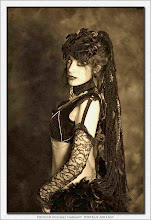
Beauty, music, bellydance, the Dark Goddess, Nature, magick, ritual-theatre, death and love.

compendium of Aepril's communications on art, beauty, bellydance, the dark, faery tale, nature, magick, ritual, theatre, death and love. The talk of a priestess and shaman of the Dark Goddess.
Showing posts with label Shamanism. Show all posts

Friday, March 16, 2012

“F” is for Forest Witch


The clearest way into the Universe is through a forest wilderness.


I am a Shamanic Witch, and my love is the Forest. 


The Forest is symbolic of the unconscious and its mysteries. It is an entryway into the Lower world, the world of shadow and transformation. In fairytales, the heroic Princess often has to travel the forest to transform herself. She meets here the Baba Yaga, the challenging Hag, the Evil Queen, the Dark Goddess, The Black Madonna, Our Lady of the Dark Forest, Our Lady of the Great Place Below…


As I continue to explore in life, I am the naïve Princess, still. And, as an initiate of the Mysteries of the Descent, I am the dark challenging Witch as well. Both sides of me roam the Wood, in the daytime and the Night, under the New Moon, the full, and the Dark. 

 I am Raven totem; the photos posted here by Pamela Joye show a ritual done in the Salem Woods under the influence of the Crow Moon. I wear a skirt by Wings of Sin depicting the Full Moon with the Black Corvid Goddess. I am The Morrigan.


 The Moon that day was in Virgo. Virgo is Virgin, “whole unto the self”. I am the Black Madonna, Our Lady of the Black Woods. She is "black, but comely", as in the Song of Songs. The unknown one. 


Spirit of Wind blesses and clears


Calling the Quarters
Bowing to the Black Madonna


I chose this time to do Magick that protects and heals, that clears away that which no longer serves, that purifies. To this end, the Great Wind Spirits, element of air, blew with mighty force, clearing away all that was destructive to this Wood. 


 The Witch of the East pulled off my hair ornaments and blew them away, challenging my vanity. 


I walk the Forest; I hold my hands in prayer for the dispossessed, the ones who can’t speak for themselves. The Coyotes who live in this Woods, raising families and hunting for food. They are vilified, but they are here because they belong; they take the place of the Wolf who once lived here. It is the absence of the Wolf that has caused the debilitating Lyme’s disease; the Wood has its lessons, if we but listen. It is the Black Madonna that holds the Coyote and Wolf close in Her arms, protecting, respecting, cherishing.

I speak with the Spirits of the Invisisbles, the Ancestors who lived in this Forest as Natives to this land. I can only guess at and envision your powerful magic and medicine.


Also to the Fae, who live and play in this Wood.


Come away, O human child!
To the waters and the wild
With a faery hand in hand,
For the world's more full of weeping than you can understand.
~William Butler Yeats, "The Stolen Child"

The Dark Lady is also Mother to the Swans and Geese at the Forest Estuary. She protects and provides for them. And the singing birds in the trees. And the trees themselves; it is said that those who understand the trees, understands herself.  Here is where the World Tree lives. All of us ARE the World Tree, and we do best to protect and love the Forest and Her gifts, to love ourselves in our complexity. 

The Forest is a kind of sanctuary, a place to become whole again. Entry in the Online Etymology Dictionarysanctuary Look up sanctuary at Dictionary.com
mid-14c., "...set apart for holy worship," from Anglo-Fr. sentuarie, from O.Fr. sainctuarie, from L.L. sanctuarium "a sacred place, shrine"... . General (non-ecclesiastical) sense of "place of refuge or protection" is attested from 1560s; as "land set aside for wild plants or animals to breed and live" 


Many Blessings on you, O Great Forest!


Monday, August 8, 2011

Spiritual Dance

I was recently asked by a friend over tea: (paraphrased) How does your spirituality influence your bellydancing? 

I answer this question differently every time I'm asked, revealing its complex and fluid nature. And it's a subject that is of great import to me. 

My forthcoming Bellydance DVD, Theatre of the Dark Goddess, deals with many threads involved in the relationship between spirit and dance. But some thoughts after reading this Wikipedia:

From Wikipedia, the free encyclopedia
 Spirituality can refer to an ultimate or an alleged immaterial reality;[1] an inner path enabling a person to discover the essence of his/her being; or the “deepest values and meanings by which people live.”[2] Spiritual practices, including meditation, prayer and contemplation, are intended to develop an individual's inner life; spiritual experience includes that of connectedness with a larger reality, yielding a more comprehensive self; with other individuals or the human community; with nature or the cosmos; or with the divine realm.[3] Spirituality is often experienced as a source of inspiration or orientation in life.[4] It can encompass belief in immaterial realities or experiences of the immanent or transcendent nature of the world.


Bellydance does indeed help me discover and rediscover my inner essence. And though its discipline and execution it is a spiritual practice. Drilling can turn into a meditation; the creation of choreography becomes a contemplation of inner archetypes. The act of creation is a ritual and a prayer. I pray to Thee, Great Goddess, that I might be a perfect conduit for your Divine Spirit.


Photo by Peter Paradise
I am most often trying to express what I experience in my inner world. As a shamanic artist I experience Underworld journey with all its shadows; it is my calling to transform the demons though my dance, giving them "voice" by being a medium for their wrath. It is shadow work--personal, yes, but collective as well.


Bellydance is ancient. It's modern form fuses back together the corporeal and the spiritual, as things were in times long ago. This is important to me. Bellydance has powerful healing properties--psychologically, physically, emotionally, spiritually. This healing power goes deeper than "body image" or self-esteem" only--it connects us back to our feminine center, the hara or place of power. I think that all of us hold in our collective unconscious "memories" of divine feminine power; Bellydance can connect us to that.


Bellydance is a great way to raise energy in ritual work! Perhaps this was part of its original purpose--to work as sympathetic magick for healthy childbirth and erotic power.


One of my first workshop teachers, Dunya of NYC, called her dance "Spiritual Bellydance". I love her great work, even--or especially--now. Her work combines the spirituality of Sufism with its whirling, with Bellydance. We were taught "Dancemeditation", a form of moving meditation that has strongly influenced the way I teach my own students the inner work of dance. It was Dunya's video that I watched over and over again to learn how to do her beautiful, graceful, fluid hand and arm work. She is a master who dances with a serenity, power and loveliness that is beyond compare.


The invisible world has much to do with dance; music itself is invisible! So is the spirit that moves us; I use dance to make my inner world visible. Some of it still stays invisible, but perceptible just the same. We have senses that perceive well beyond what the "five senses" can do; it is partly what we perceive with our other senses that gives dance--as experienced as audience and as dancer--its magic, its beauty, its feelings of sacred communion, and glamour. Spirit.  


Sunday, July 17, 2011

Bellydance Costuming as Art

I recently read an interview in a national Bellydance mag with a respected and widely sought after Bellydance teacher and performer. When asked for advice she would impart to new dancers, she said (and I paraphrase) that one should spend more money learning the dance via workshops, classes and videos, than on costuming.

As a Bellydance teacher, I agree. Albeit with some reservation.

I agree, if one's main focus is on becoming an excellent Bellydancer. To become a Bellydancer with a capital "b", it takes years of dedication to learning the form, cultural context, history, and traditions of this dance. Correct technique, form and fitness are a must. One must attend shows and events to watch other dancers, and learn the difference between styles. It takes many years of study to become a master, and to find ones own voice.

So what is it that makes me uneasy about this idea that costuming should only come later, AFTER one has become an advanced dancer?

Well, let me tell you a bit about myself. I'm a Bellydancer, but I consider myself to be an Artist first. Bellydance is one medium that I use to express my inner world. (I'm also a musician, actor, poet, and I've been known to paint and sculpt once in a while, too.)

I'm a Shaman. It's my job in this incarnation to interpret the underworld and inner Archetypal landscape to the community. The medium is not the important thing; that's only the vehicle. I'M only the vehicle. It's more about the message; the content. It's about the embodiment of spirit, and communication between the invisibles and the audience.


For me, costuming is a major part of the art, part of the ritual. The making of the costuming is a part of a contemplative practice. Sometimes other people make the costumes for me (I'm bad at sewing) but in this case the envisioning of the costume is the art. What would The Morrigan wear to tell her story? How would She appear? I let Her tell me.

I spend many hours opening myself up to spirit, listening to what I'm being told. I also do a ton of research. Once an archetype talks to me, and I know that I will be performing her, I do my homework and find everything I can about her mythology and history. As a primarily right-brained person, I work with the symbols I find and make connections between them. It is in this way that I create my theatrical persona.

I then become this character. I practice being her. I practice being her walking down the street, etc. She becomes more and more solid this way. Once I hit the stage, I'm as ready as I can be to channel her.

Self-portrait as The Washer at the Ford

So, my orientation toward Bellydance has been different from many. I love this dance for its own sake, deeply and truly. But I do it as an Artist/Shaman first, not as a Bellydancer first. It took me many years to realize that fact fully; with all the pressure to become an expert on Middle Eastern culture, to be fully versed in every bit of dance vocabulary possible, to know all the drum rhythms and their names, to fit into the Bellydance community. I've had quite a journey, and I've learned who I am and who I am not: I am NOT a keeper of tradition, though I am well versed in it. I'm very glad that some people are keepers, but this is not my path. 

Yes, I think that technique and form are paramount to being a master dancer--how else could one tell a story well? My tools need to be effective and sharp, and that means continuing to improve my dance skills, honing my craft, making my work better and better. The more control, elegance and athleticism I can express with my body, the happier the archetype will be to speak through it.


Would I tell my students to work on their dance skills first, and only then spend their money on costuming?

Here's what I would say: If you aspire to be a dancer, you need to know how to dance. It is not OK to hop onstage with a great costume but not be able to dance well. Not if you want to call yourself Bellydancer. Whatever art form you use, you need to hone your craft before you present to the world.

HOWEVER, costuming and creating persona is an art form, too. It needn't come second. Creating costuming can help you find your voice, and give you impetus to learn technique. Beauty loves to show itself. But it requires right timing. Pay close attention to your body and its feelings; it will tell when you are ready. If you create a beautiful costume to wear, give your art what it deserves and dance it well. Or sing it well. Or act it well. If it is your inclination, be an artist on every level you can.

There are many valid approaches. For me, costuming is not decoration on what is essentially technical prowess, nor is it icing on the cake or anything like that. The movement needs to have meaning, the costume does, too. The art is made as a whole.

Saturday, June 25, 2011

The Four-fold Way: An Approach to Performance

I've written what is below based on anthrologist and author Angeles Arrien's "Four Fold Way", a mode of being and practice that is harmony with the deep self and with Nature.

I teach this to my students as a way to approach performance. It is how I endeavor to approach performance. It is also an approach to LIFE!

The Four-fold Way:
1.       Show up:
be present in mind body and spirit.
2.       Pay attention:
Quiet the "noise" of the mind. Sense fully what is currently going on around you. Listen to your body and to the music, note by note. Do not go forward or back in time.
3.       Tell the truth:
 
Be authentic! Be where you are now, as opposed to where you'd like to be. Feel what you are really feeling; your body will always tell you how to do this. Dramatic art versus pretension.
 
4.       Be unattached to outcome: 
 
Staying fully in the present ensures the best outcome. Keep your mind focused on what you are doing, as opposed to what you will do or what you did do. Let go of judgment. Open yourself to life, be a medium for energy as opposed to controlling it. TRUST yourself fully and unconditionally!